Lighthouse Facts and Figures
-
The co-ordinates for the base of the Lighthouse tower:
Latitude 0580 37' 31.59" N
Longitude 0040 59' 56.10" W
-
Light Established: 1828
-
Engineer: Robert Stevenson
-
Character of Light: Flashing (4) white every 30 seconds
-
Elevation: 122 metres
-
Candle Power: 204,000 candles
-
Nominal Range: 24 miles (22 nautical miles)
-
Structure: White Tower 20 metres high
-
There are 81 steps to the top of the tower
-
Fog Horn: Siren 90 seconds 6 blasts
Lighthouse tower and dwelling houses are listed as buildings of Architectural and Historic Interest.
|

|
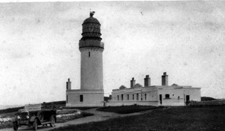
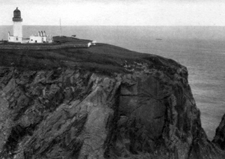
The Cape Wrath lighthouse stands over one hundred and twenty one metres high above mean sea level
on spectacular cliffs facing the stormy Atlantic Ocean.
The buildings are extensive and spacious, surrounded by a high wall.
The white tower is twenty metres high with eighty one steps to the top.
The tower is built of hand dressed stone and the rest of the building is constructed of large blocks
of granite quarried from Clash Carnoch.
|
|
For an idea of the shipping that passes Cape Wrath, please visit the
interactive Shipping AIS map that can be found here
|
|
A Brief History/General Background Information
An Act of Parliament created the Northern Lighthouse Board
(The "Board") in 1786, authorising the construction of four lighthouses in Scotland and the establishment of a
Commission for their administration. The Commissioners appointed at that time were the Law Agents of the
Crown, Sheriffs of Coastal Counties and the Provosts and Lords Provost of Scottish Towns and Cities whose
mercantile interests were involved. Over the years the numbers of the Board varied and further changes were
brought about by the local government and sheriffdom reorganisation. Today, all Scottish Sheriffs-Principal
are members of the Board along with the Lord Advocate, Solicitor General, Lords Provost of Edinburgh, Glasgow
and Aberdeen, Provost of Inverness, The Chairman of Argyle & Butte District Council, a nominee from the
Isle of Man and a further five co-opted members who serve for a period of three years and three of whom must
have nautical experience.
From the original four lighthouses the number of lights administered throughout Scotland, the adjacent seas
and islands and the Isle of Man (which was brought within the Board's jurisdiction in 1815), has increased
to 191 of which 50 were permanently manned and 141 unmanned. In addition to these lights, the Board is
responsible for the buoyage and marking by means of beacons of navigational hazards within their area of
jurisdiction. Of the approximate number of 150 buoys along the Scottish and Manx coasts, about half are
lighted. None of the 31 beacons are lighted.
Manned lighthouses were divided into two main categories, Rock or Relieving Stations and Mainland Stations.
A Relieving Station is virtually a Rock Station on the mainland so remote that it is unsuitable for wives
and children to reside there. At these Stations and Rocks, the light keepers on duty live alone, their
families being resident at a shore station, usually in the nearest town or city. There were six light keepers
assigned to this type of station, three of whom were on duty at the lighthouse at any one time. The light
keepers served a month on duty and a month ashore and were relieved by attending boat, tender or helicopter.
Four light keepers were appointed to important Mainland Stations where fog signals and radio beacons are
established. Stations without fog signals were manned by two or sometimes only one light keeper. Furnished
dwelling houses were provided for all mobile keepers whose tour of duty at any one station averaged around
four years. Some stations had local assistant light keepers who remained at a particular station, were
classed as non-mobile and didn't have houses provided by the Board. Each lighthouse was in the charge of a
Principal Light keeper who had under him up to three Assistants. Two Principal Light keepers were attached
to Rock and Relieving Lighthouses. Occasional Light keepers were also employed on a part-time basis to do
duty when required to allow the regular keepers annual leave and their respite periods and to substitute in
cases of sick absence. For the relief of Rock Lighthouses, delivery of stores (oil, paint, machinery spares
etc.) to rocks and stations where road access is difficult the Board has three ships (lighthouse tenders),
and a helicopter on contract to carry out these tasks. The three tenders, MV PHAROS (1712 tonnes),
MV FINGAL (1342 tonnes), and MV POLE STAR (1328 tonnes), are based at Leith, Oban and Stromness, respectively.
They each carry a crew of about 30 officers and men, with additional accommodation for officials and light
keepers, have adequate hold and deck space for lighthouse stores and buoys.
The mention of buoys features of course, another area of activity for the tender whose responsibility it is
to maintain the many buoys positioned off the Scottish and Manx coasts. They are also required to undertake
the often-painstaking search and recovery of floating objects or obstructions considered hazardous to
navigation. Regular trips to the oil fields are now encompassed in the ships programmes so that the navaids
carried by the oilrigs may be checked for compliance with requirements.
The commodore ship of the fleet is the MV PHAROS and it is on board the PHAROS that the Commissioners
carry out their annual inspection of selected lighthouses.
The relief of most of the Rock Lighthouses is now effected by helicopter and the anxiety which many light
keepers experienced on relief day as to whether the sea would remain calm enough for a successful relief
is now happily only a rather unpleasant memory. The helicopter has of course proved to be a valuable asset
in many ways. Apart from the reliability, speed and comfort in relief operations, it is utilised in
conjunction with the MVs FINGAL and POLE STAR, both of which have been fitted with helidecks, to service
many of the minor automatic lighthouses where previously, accessibility was always something of a problem.
The ability to transport loads underslung also qualifies the helicopter as an extremely useful workhorse.
The Board does not own a helicopter but prefer to have the exclusive use of an aircraft on contract. The
present contractors are North Scottish Helicopters Ltd and the helicopter is a twin-engined MBB Bolkow 1050
which seats 5 including the pilot and is ideally suited for lighthouse work. As one would imagine homes for
the stores and buoys previously mentioned are a necessity and those are found at the Depots located in
Granton, Oban and Stromness. The latter two, as well as providing berthing and fuelling facilities for the
tenders see much helicopter activity as they fulfil the role of bases for the West and North airborne
operations.
Each Depot has an Officer-in-Charge, an Assistant Officer-in-Charge and varying numbers of staff to carry
out the numerous duties involved in the day to day functioning of their particular section of the
establishment.
In an organisation whose tendrils reach as far north as the northern most peninsula in Shetland and as far south
as the Calf of Man, it is essential to have a nerve centre and this is found behind the Georgian edifice of
84 George Street, Edinburgh. Known, not unnaturally throughout the Service as "Headquarters".
There, under the General Manager, the staff falls mainly into two sections, Administrative and Technical.
In the former the Secretary controls the functions of the Administration, personnel and Accounting
Departments, and in the latter those of the Superintending, Civil, Mechanical, Electrical and Radio
Departments are under the direction of the Engineer-in-Chief. Also in the Headquarters Building are located
the Workshops which are well equipped to service all lighthouse machinery, electrical, radar, and radio
installations.
The Workshops are manned by Technicians and Artificers, many of who are out on the district servicing and
repairing equipment on the spot for approximately six months of the year.
The Northern Lighthouse Board is one of the three Lighthouse Authorities in the United Kingdom and Ireland,
and the costs of running the three Services are met from a General Lighthouse Fund. This fund is financed by
the collection of Light Dues paid by British and Foreign-Going ships calling at ports in the United Kingdom
and Eire. The fact that the fund is administered by the Department of Trade may give rise to the popular
belief that Lighthouse Authorities are public funded and are therefore Government Departments. This, however,
is not so, the fund is self-financing and receives no grant whatsoever from the Exchequer. The powers and
duties of the three Lighthouse Authorities are embodied in the Merchant Shipping Act of 1894, which is the
standard reference on the subject. In its early days the Northern Lighthouse Board was fortunate to have
employees whose ideals were of the highest order, people who were dedicated to the service and safety of the
mariner. Today these ideals are a tradition that is imbued within every member of the Service however small
or great a part they play in achieving the fulfilment of the Board's Motto: "In Salutem Omnium"
(For the Safety of All).
Historical Items about Cape Wrath Lighthouse
The light at the lighthouse, shone for the very first time on Christmas day 1828.
On 17 January 1977 the helicopter carried out the Cape Wrath Relief - a history making moment as this was
the first helicopter relief carried out at a shore-based Scottish lighthouse. As the lighthouse is not easily
accessible by road, all stores including household goods and spare parts as well as the diesel and paraffin
oil required to power the machinery are landed once a year by the Lighthouse Tender MV PHAROS, whose duty it
is to convey stores to the isolated lighthouses along the Scottish and Manx coasts.
In 1978 the paraffin vapour burner was replaced by mercury vapour lamps and in January 1980 an electrically
operated temporary power beam was installed. In December 1980 a completely new gearless pedestal and lamp
array system was installed.
Cape Wrath Lighthouse was converted to automatic status on 31 March 1998 and is now remotely monitored from
the Northern Lighthouse Board’s offices in Edinburgh.
In 1999, John & Kay Ure began the long process of renovating the old lighthouse keepers cottage, with the
intention of eventually moving in and living there - as well as opening a cafe.
Due to bridge of the modern day's merchant ships now being enclosed, as well as the widespread use of electronic
position finding aids and radar, the use of the fog horn as a warning has been significantly reduced, and thus,
all fog horns have now been turned off. This began with the ones at Cape Wrath, Copinsay, Fair Isle North and
Rattray Head in 2001.
On the 1st of June, 2009, The Ozone Café - which is the remotest
café on mainland Britain, was open for business for the very first time. Since then, it has never closed -
open 24 hours a day, every day of the year.
Back to Top
|